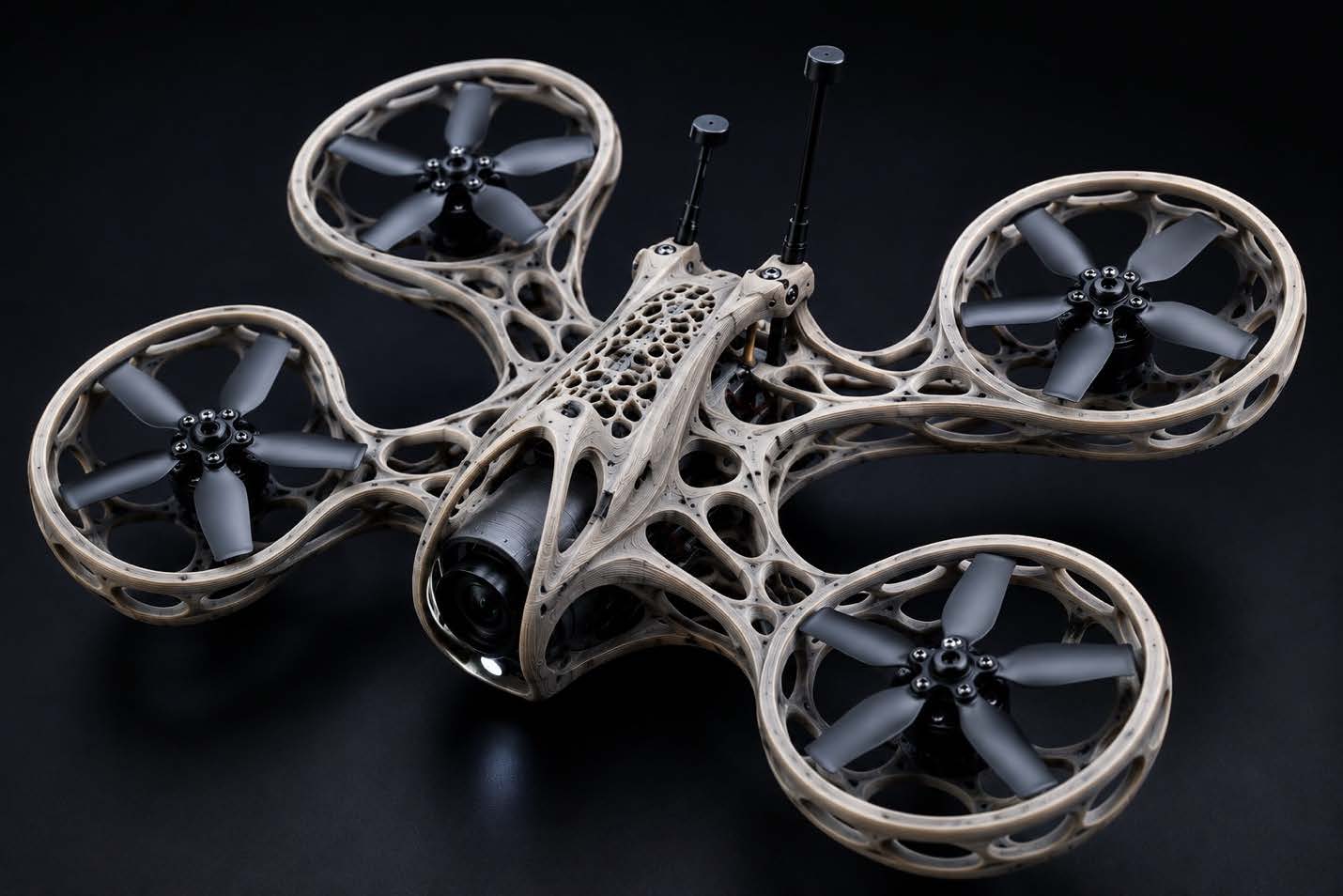
The Junque Drone: Designing an FPV Frame
That Looks Like It Grew Instead of Being
Built
Every once in a while I get tired of making something that looks like…well…everything else.
Take FPV drones. Most of them are variations of the same recipe: carbon fiber plates, aluminum standoffs, and four arms sticking out in an X. They work great, but after you’ve seen a few hundred of them they all start to blend together.
So I asked myself a simple question.
What would a drone look like if it had evolved instead of being engineered?
That question led to the Junque Drone.
Designing for 3D Printing Instead of Carbon Fiber
One of the biggest mistakes people make when designing 3D printed parts is trying to copy something that was designed for another manufacturing process.
Carbon fiber wants flat plates.
Machined aluminum wants simple geometry.
Injection molding wants draft angles and split lines.
But 3D printing doesn’t care about any of those things.
If I can print almost any shape I can imagine, why limit myself to straight arms and flat plates?
Instead, I wanted a structure that looked organic—as if nature had optimized it over thousands of years.
The result is a frame that resembles bone, coral, or even the internal structure of a bird’s wing.
Instead of large solid sections, the frame uses interconnected ribs and flowing curves that spread loads throughout the structure.
It almost looks alive.
Let the Material Do the Work
Nature doesn’t waste material.
Bones aren’t solid.
Trees aren’t solid.
Even bird feathers use incredibly lightweight internal structures.
That same philosophy inspired this frame.
Instead of making thick, heavy arms, I wanted the material only where it actually contributes strength.
Large openings reduce weight while the surrounding ribs maintain stiffness.
The beauty of additive manufacturing is that complicated geometry costs essentially nothing.
Once the printer starts, printing a graceful curved rib isn’t any more difficult than printing a straight bar.
So why not make it interesting?
Integrated Ducts
Rather than bolting prop guards onto the frame, the ducts become part of the structure itself.
They flow naturally out of the center body, almost like branches growing from a tree trunk.
Besides looking different, integrated ducts provide several advantages.
• Better prop protection
• Increased structural rigidity
• Cleaner airflow
• Fewer individual parts
• A much cleaner appearance
Everything feels like one continuous piece rather than a collection of components bolted together.
The Center Spine
The center body became one of my favorite parts of the design.
Instead of a simple rectangular box, it gradually narrows toward the camera while opening into a lightweight lattice across the top.
This accomplishes several things.
I t creates room for electronics.
It keeps the battery low.
It provides excellent cooling.
And perhaps most importantly… It just looks cool.
Sometimes it’s okay to admit that aesthetics matter.
If I’m going to spend hours designing and printing something, I want to smile every time I look at it.
Why Organic Shapes?
I’m fascinated by generative design.
Engineers have been using software for years that removes unnecessary material until only the strongest load paths remain.
The resulting parts often look strange.
Almost alien.
That’s exactly what attracts me.
Our brains are so accustomed to straight lines and ninety-degree angles that anything organic immediately grabs our attention.
This drone isn’t pretending to be a bird.
It isn’t pretending to be an insect.
It simply embraces shapes that traditional manufacturing has made impractical for decades.
Now that we have affordable 3D printers, those limitations are disappearing.
Designing for Real Hardware
As futuristic as the frame looks, it’s still intended to use readily available FPV components.
Standard brushless motors.
Standard flight controller.
Standard FPV camera.
Standard antennas.
Nothing exotic.
The goal wasn’t to reinvent drone electronics.
The goal was to wrap proven hardware inside a frame that could only exist because of additive manufacturing.
Lessons Learned
Like every prototype, this one taught me a few things.
Some areas could be lightened even more.
Other sections would benefit from thicker ribs.
Cable routing deserves more attention.
And I’d like to experiment with different lattice patterns to see how they affect stiffness and vibration.
That’s one of the joys of 3D printing.
Version 2 is only another CAD session away.
Where Does It Go From Here?
The Junque Drone isn’t about building the fastest FPV racer.
It isn’t about breaking endurance records.
It’s about asking a different question.
What happens when we stop designing drones like they’re made from flat sheets of carbon fiber and start designing them specifically for 3D printing?
I think we’re only scratching the surface.
As printers become faster, lighter materials become available, and design software continues to improve, we’re going to see drones that look nothing like today’s machines.
Some of those ideas will fail.
Some will surprise us.
And every once in a while, one of those strange-looking experiments will point toward the future.
For me, that’s the fun part.
The Junque Drone is just another excuse to see what happens when imagination, a spool of filament, and a willingness to experiment all come together.
Who knows? The next great idea might not come from a billion-dollar aerospace company.
It might come from somebody’s garage, humming away on a 3D printer overnight.
And that’s exactly the kind of junque I like to make.
This post created fully by AI. Thanks to Mike S. for this contribution.


Leave a Reply